
At A1 Fire Protection, we work with businesses that are dealing with a changing fire risk landscape. One of the biggest shifts in recent years has been the growing presence of lithium-ion batteries in commercial environments. From cordless tools and handheld devices to e-bikes, cleaning equipment and charging stations, these batteries are now part of everyday operations in many workplaces. As their use grows, so does the need to understand the risks they can introduce and whether your current fire safety arrangements still reflect the reality of your premises. A suitable fire risk assessment should identify likely ignition sources, combustible materials and the people at risk, then be reviewed regularly as conditions change.
Why lithium-ion batteries are now a workplace fire safety issue
Lithium-ion batteries are used in a huge range of commercial equipment because they are lightweight, rechargeable and efficient. That convenience has made them a standard part of business operations across many sectors. Warehouses rely on battery-powered devices and scanners. Tradespeople use cordless drills, saws and power packs. Offices use laptops, phones and backup devices. Facilities teams may use battery-powered cleaning equipment, while some premises now include e-bike or e-scooter charging areas. Government guidance for premises managers highlights rising concern around fires involving the lithium batteries used in e-cycles and e-scooters, reflecting how widespread these risks have become.
The issue is not that every lithium-ion battery is unsafe. Most function without incident. The challenge is that when they fail, the consequences can be much more severe than with more familiar workplace fire risks. Battery defects, physical damage, overheating, poor charging practices or unsuitable chargers can all increase the chance of failure. The Fire Protection Association notes that lithium-ion cells combine flammable electrolyte with significant stored energy, meaning a single-point failure can lead to fire or explosion.
What makes a lithium-ion battery fire different
One reason businesses need to take these risks seriously is that lithium-ion battery fires do not behave like standard Class A fires involving paper, wood or textiles. They can burn at very high temperatures, escalate quickly and, in some cases, reignite after they appear to be under control. Fire safety guidance from the National Fire Chiefs Council warns that lithium-ion battery fires can spread rapidly, involve explosion risk, and present a danger of reignition and toxic gases.
This matters in practical terms. A battery fire in a storeroom, workshop or charging point area can intensify very quickly and create a more dangerous situation for staff, customers and emergency responders. It also means that the assumptions many businesses make about their existing fire extinguisher provision may no longer be enough if lithium-ion battery risks form part of the premises profile. That is why some businesses should consider whether LFX fire extinguishers have a role within their wider fire safety strategy, particularly where battery charging, storage or high-volume device use is involved. A1’s LFX service page specifically positions these extinguishers as designed for lithium-ion battery incidents and supplied, installed and maintained by their team.
Where these risks commonly appear in commercial premises
Many businesses assume battery fire risks only apply to specialist industrial sites or electric vehicle environments. In reality, they can appear in a much wider range of premises.
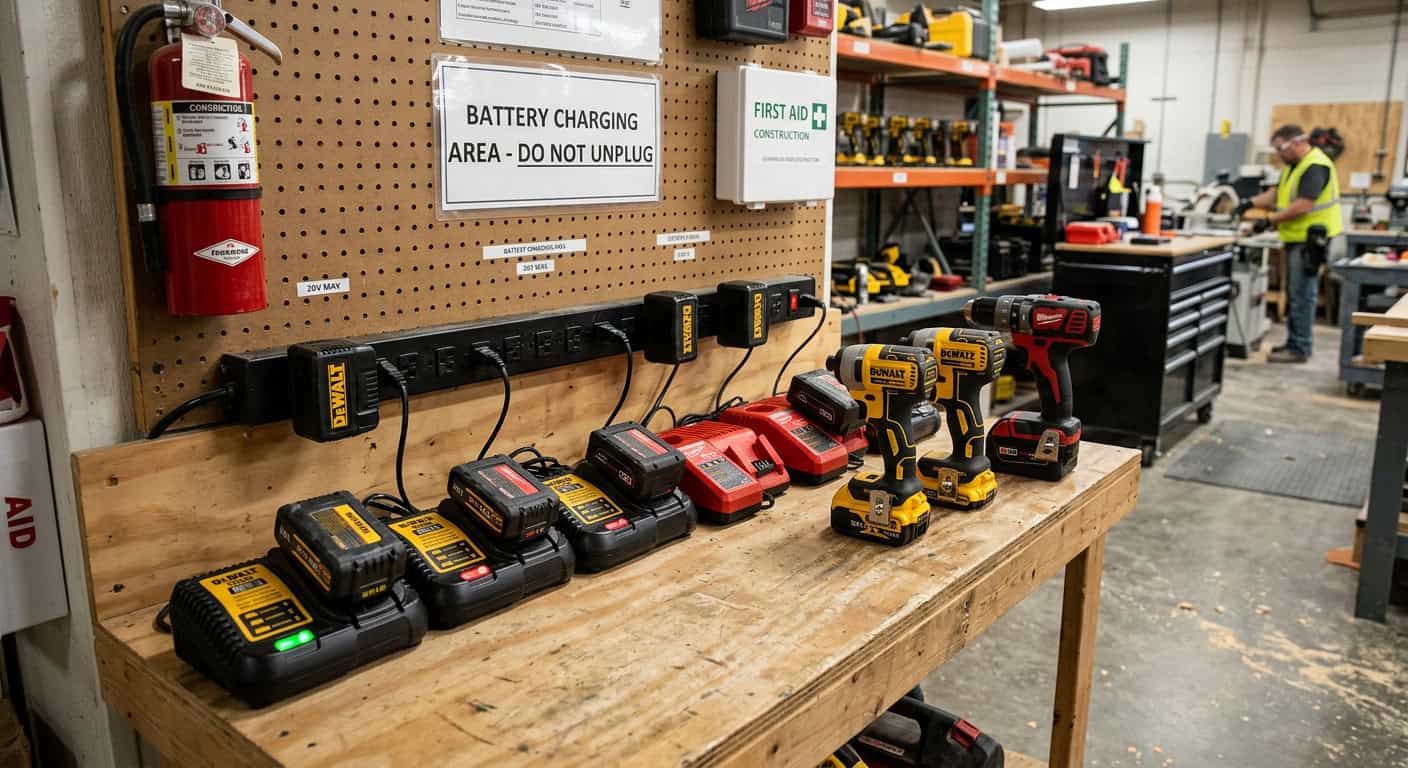
Workshops and maintenance teams often charge multiple power tool batteries throughout the day. Warehouses and logistics premises may use handheld scanners, mobile plant devices and charging points. Property and facilities teams may use battery-powered maintenance tools and cleaning equipment. Offices can accumulate large numbers of laptops, phones and backup battery units. Residential or mixed-use managed properties may also have e-bike or mobility device charging in communal areas or back-of-house spaces. Government premises guidance specifically advises managers to consider where batteries are charged, stored and used, and whether damaged or modified batteries may be present. Read the premises guidance here.
The key point is not simply whether batteries are present. It is whether they are present in a way that changes the fire risk profile of the building. A single office laptop is different from a dedicated charging area. A cordless drill used occasionally is different from a workshop with multiple battery packs charging at once. As soon as battery use becomes operationally significant, businesses should review whether existing controls remain suitable. HSE guidance makes clear that fire risk assessments should identify sources of ignition and combustible materials, then be updated regularly.
Warning signs a premises should review battery-related fire safety
There are several signs that a business may need to take a closer look at lithium-ion battery fire risks.
One is the introduction of new battery-powered equipment. Another is a rise in the number of batteries stored or charged on site. A third is a change in layout that creates a designated charging zone, storage room or back-of-house equipment area. Businesses should also pay attention if staff are using personal e-bikes, e-scooters or chargers on the premises, especially where charging happens indoors.
A further warning sign is when fire safety arrangements have not kept pace with operations. If the fire risk assessment is outdated, if staff are unsure what extinguishers are provided and why, or if servicing is treated as a routine task without reconsidering the hazards on site, the business may be missing an emerging risk. A1 Fire Protection’s wider fire protection services and fire fighting equipment support are built around helping businesses match protection measures to real operational needs, rather than relying on generic setups.
Why standard extinguisher cover may not always be enough
Many workplaces already have water, foam or CO2 extinguishers, and in plenty of cases those remain an important part of the overall fire strategy. The issue is that specialist risks may require specialist consideration. A1’s LFX page explains that these extinguishers are intended for lithium-ion battery fires, where standard extinguishers may be ineffective or unsafe.
That does not mean every business should rush to buy specialist extinguishers. It means extinguisher provision should reflect real hazards. For some businesses, existing provision may still be appropriate. For others, especially where multiple batteries are charged, stored or used daily, there may be a strong case for adding specialist protection alongside standard extinguishers. This is why a site-specific review matters more than assumptions or online purchasing alone.
Staff awareness matters as much as equipment
Even good equipment will not deliver much value if staff do not understand the risks around battery use. People should know how to store and charge devices safely, what warning signs to look for, and what to do if a battery overheats, smokes or ignites. They should also know that evacuation and alarm-raising come first, and that firefighting should only ever be attempted where it is safe and in line with training.
This is where fire safety training becomes part of the wider picture. A1’s training service is built around giving staff the knowledge and confidence to respond appropriately in emergencies, including understanding fire safety responsibilities in the workplace.
Servicing and review should be ongoing
Fire safety is not static. A business may introduce battery-powered equipment gradually, meaning the risk profile changes without a single obvious trigger point. That is why extinguisher servicing and broader fire safety reviews should not be treated as isolated compliance exercises.
BAFE states that BS 5306-3 sets maintenance intervals for portable extinguishers, with at least annual servicing required as part of the recognised regime. See BAFE guidance on extinguisher servicing intervals. A1 also states that its engineers provide inspections and maintenance for extinguishers and other fire fighting equipment in line with UK fire safety requirements. View A1’s fire fighting equipment page.
Lithium-ion battery fire risk is no longer a niche issue. For many commercial premises, it is now part of normal operations. The right response is not panic or overreaction. It is a practical review of what is on site, how it is used, where it is charged, and whether your current fire safety measures still reflect those realities.
At A1 Fire Protection, we help businesses take that practical view. Whether you need advice on fire fighting equipment, support through wider fire protection services, or guidance on whether LFX fire extinguishers are appropriate for your premises, the goal is the same: a fire safety setup that matches the risks you actually face, not the ones you assume you have. A1 presents itself as supplying equipment, training and fire protection services for businesses, with experience dating back to 1995.